Michel Velleman — born in Groningen on 5 January 1895 and, under the stage name Ben Ali Libi, a beloved Dutch magician — is one of the most moving figures in Dutch magic history. During the Second World War he was murdered by the Nazis; his name lives on through a famous poem.
Visual reference
Youth and stage name
Velleman was born the son of merchant Jesajas 'Jacques' Ruben Velleman and Aaltje Noort. He was the second son in the family, a year younger than his older brother Ruben, who became a photographer. Because of his father's work the family moved often — from 's-Hertogenbosch and Rotterdam to Antwerp — before finally settling in Amsterdam. In 1916 he married Anna Speijer.
The stage name Ben Ali Libi had existed since 1907. From 1912 Velleman first performed as 'Ben Ali Libi Jr', and from 1920 he toured the country as Ben Ali Libi.
A beloved magician
The Nieuwsblad van het Zuiden wrote in 1924 that Ben Ali Libi was 'a deft sorcerer' who 'astonishes those present with his incredible feats', and that 'a whole evening with this sorcerer alone would bore no one'. He performed, among others, for Prince Hendrik and for the German former Kaiser Wilhelm.
By day he performed magic for children; in the evenings he appeared in full-length cabaret shows alongside artists such as Johnny & Jones, Marie Hamel and John de Leeuw. In 1927 he could even be heard on the radio in a children's programme.
War and deportation
Velleman kept working even during the occupation. After ever-harsher measures he went to work for the Cultural Department of the Jewish Council and gave magic lessons at home; one of his final performances took place on 24 May 1942.
During the raid of June 1943 he was arrested together with his family at their home on the Merwedeplein in Amsterdam. By way of Westerbork transit camp he was deported to the Sobibór extermination camp, where he was murdered on arrival on 2 July 1943. His son was not at home, was warned, and was the only member of the family to survive the war.
A name that lives on
Ben Ali Libi became known to a wide audience through the eponymous poem by Willem Wilmink. He got the idea from the book 'Door de nacht klinkt een lied' (1985) by Henk van Gelder, in which he came across the name Ben Ali Libi in the register of murdered artists. Encouraged by his friend Joost Prinsen, Wilmink wrote a poem in 1987 about a 'little Jewish schlemiel' who, despite his conjuring skills and a carefully chosen alibi, could not hide from the unimaginative followers of Hitler's Third Reich.
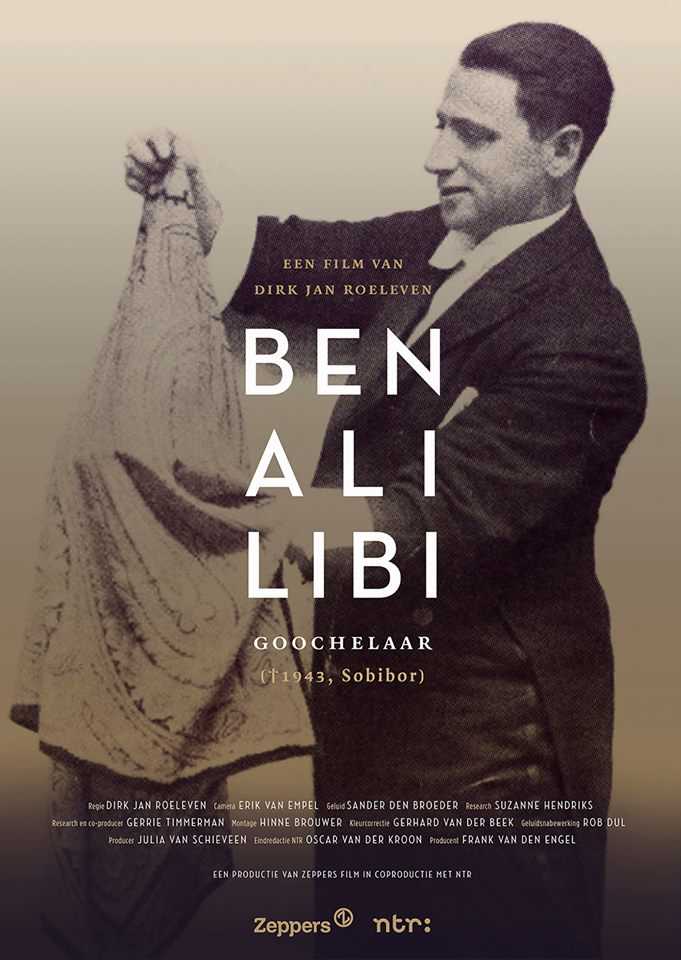
After the composer Harry Bannink set the poem to music, Joost Prinsen performed the song in the theatre programme TipTop (1996) and recited it in 2004 in a documentary about Wilmink. The poem moved many — including Bram Moszkowicz, who on television in 2012 called it his motto in life — and prompted the documentary 'Ben Ali Libi - goochelaar' by Dirk Jan Roeleven in 2015. In this way it grew into a moving tribute.
In Amsterdam a bridge has been named after him since 2017, a memorial stands at his birthplace in Groningen, and since 2021 Stolpersteine at the Merwedeplein commemorate his fate. In this way the memory of this beloved magician, a victim of the Holocaust, has been preserved forever.
The story of Ben Ali Libi reminds us how precious the art of wonder is, and how important it is to keep it alive. With respect for that rich history, Sudesh Roman carries the Dutch magic tradition forward today.