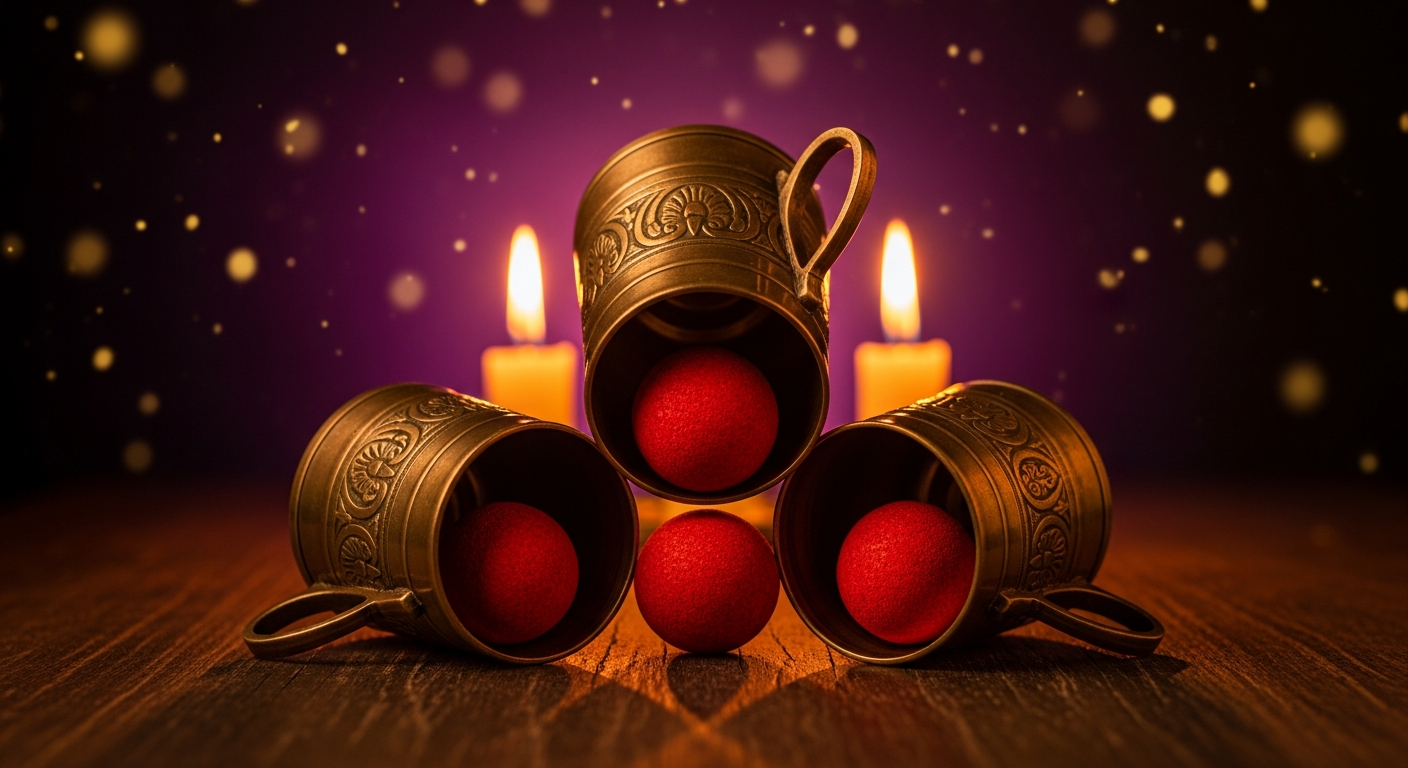
Three cups, three balls. The magician lifts a cup, suddenly there are two underneath. He lifts the next, empty. The third, three balls. This trick was already performed in ancient Egypt, and it still amazes today. How can something so simple work for 4,000 years?
The history: from Egypt to Las Vegas
The earliest depiction of Cups and Balls is a wall painting from the tomb of Baqet III in Beni Hassan, Egypt, around 2500 BC. The Roman emperor Seneca described the trick as 'acetabularii' (from 'acetabulum', vinegar cup). In the Middle Ages it became the trick of market magicians and wanderers.
In the 17th century it was standardised: three cups, three balls, and a 'climax' with large objects (lemons, oranges, sometimes even small chicks). Dai Vernon, the greatest magician of the 20th century, called Cups and Balls 'the trick you can spend a lifetime on'.
- ✦First documentation: 2500 BC, Egyptian tomb
- ✦Roman name: acetabularii (vinegar-cup players)
- ✦Standard form: 3 cups + 3 balls + climax objects
The technique: the stolen ball and the final load
The heart of the trick is the 'steal' and the 'load'. In the steal, the magician picks up a ball secretly while appearing to do something else, for example, picking up a cup. In the load, he stealthily drops the ball under a cup as he sets it down.
Both moves are physically trivial, but it's timing and misdirection that makes them invisible. The magician looks at the audience at the critical moment, or asks a question. What the hand does is clearly visible, for those looking. But nobody is looking at the right moment.
The climax (a large lemon under the cup, while the audience expects balls) is often a separate technique: the 'final load', placed under the cup in advance and kept there throughout the show without anyone noticing.
The psychology: rhythm and repetition
Cups and Balls works through rhythmic repetition. The magician builds a pattern (lift, move, lift), so the spectator's brain adapts to that pattern. Then he breaks the pattern, and that is exactly when the real trick happens. The brain is on 'autopilot' and misses the deviation.
The physical proximity adds extra impact. The audience sits close, sometimes touching the cups. There's no camera, no stage, no distance to hide behind. And yet the balls keep escaping.
Four millennia old and still unexplained. Cups and Balls proves that magic isn't about technology or spectacle, but about the eternal wonder when something simple does something impossible, right in front of your nose.