Étienne-Gaspard Robert (Liège, 15 June 1763 – 2 July 1837), known by the stage name 'Robertson', was a prominent physicist, stage magician and influential developer of phantasmagoria from the Prince-Bishopric of Liège. Charles Dickens described him as 'an honourable and well-educated showman'.
Visual reference
Scientist and artist
Robert was born in Liège, studied at Leuven and became a professor of physics specialising in optics. He was also an avid painter who at first intended to pursue a career as an artist in France; in 1791 he moved to Paris, where he made a living as a painter and draughtsman.
There he attended lectures in the natural sciences at the Collège de France, including those by Jacques Charles, an important figure in the history of ballooning, who would become his mentor. In 1796 Robert proposed to the French government that he set fire to British naval ships using enormous mirrors to focus sunlight — an idea based on the myth of the mirrors of Archimedes. The government turned it down. He did, however, give public demonstrations of his research into galvanism and optics throughout the 1790s.
The Fantoscope
Robert probably attended one of Paul Philidor's phantasmagoria shows in Paris around 1792 or 1793. With his understanding of optics he had little trouble working out how Philidor's ghosts were created with the magic lantern, and he went on to develop his own, far more refined version of that pre-cinema horror show.
Inspired by the work of the seventeenth-century scholar Athanasius Kircher, he built an improved magic lantern with adjustable lenses and a moveable carriage, allowing him to change the size of the projected image and to show several images at once using more than one glass slider. In 1799 he received a patent for his 'magic lantern on wheels', which he named the Fantoscope. Especially in a smoky room, the device produced a ghostly effect.
Ghost shows in a convent
Robert gave his first performance on 23 January 1798 at the Pavillon de l'Echiquier. His charisma and the never-before-seen visual effects left the audience convinced they had seen real ghosts, and many were terrified. After being investigated by the authorities, the show was shut down in Paris. Robert moved to Bordeaux, where he experienced balloon flight as a passenger for the first time — an experience that would profoundly change his life.
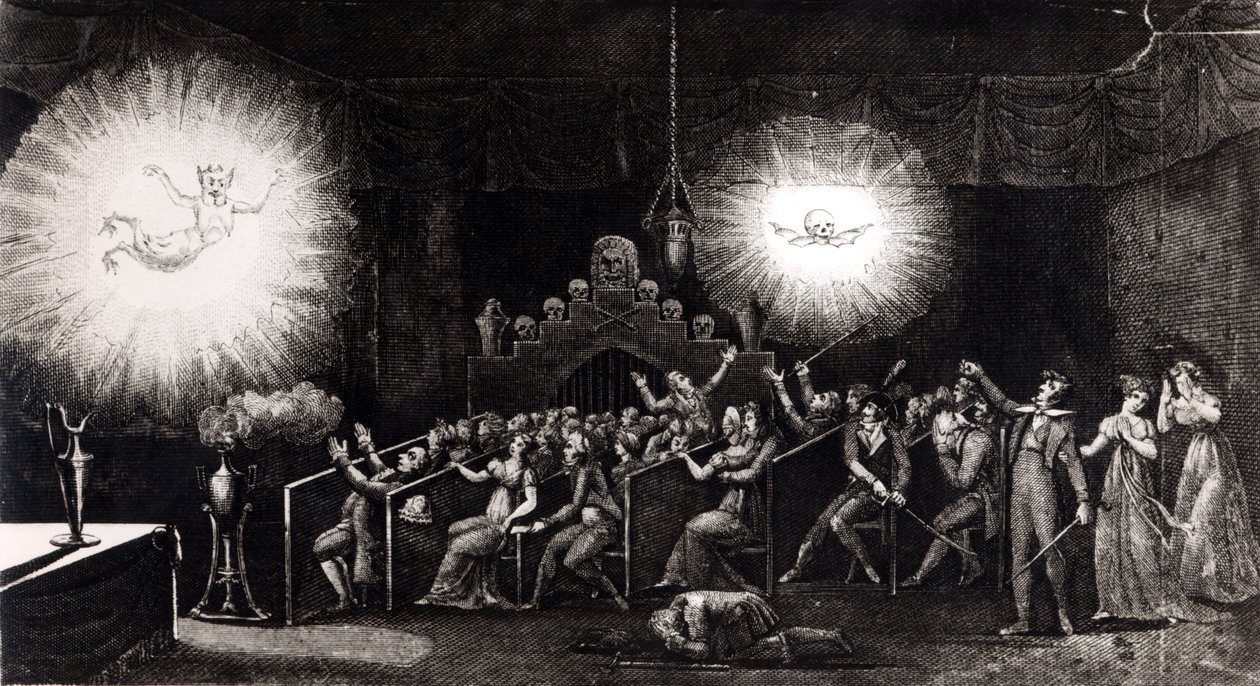
Back in Paris he discovered that two former assistants had continued the performances without him. He refined the show and from 3 January 1799 performed in a permanent home: the crumbling Convent des Capucines near the Place Vendôme, whose Gothic surroundings formed the ideal eerie setting. On the way in, the audience was treated to optical illusions and trompe-l'œil; in the candlelit room came wind, thunder and an unsettling glass harmonica. After a monologue about death and the afterlife, Robert projected his apparitions into the smoke — using rear projection, wax-coated gauze and the interplay of smoke and mirrors, he even conjured the faces of French heroes such as Marat, Voltaire and Rousseau.
Balloonist and legacy
Alongside his shows, Robert was a keen balloonist who designed and flew balloons in several countries. On 18 July 1803 he set an altitude record in Hamburg in a montgolfière, and he devoted countless flights to meteorological research, with observations of barometer, thermometer, cloud formations and solar radiation. In 1806 an audience of fifty thousand, including the royal family, gathered at Rosenborg Castle in Copenhagen to watch him ascend; he flew all the way to Roskilde and made a deep impression on the Danish physicist Hans Christian Ørsted, who wrote poems about it.
He performed his phantasmagoria in the convent for four years and then toured Russia, Spain and the United States, among others. On 14 May 1826 he officially opened the third Jardin de Tivoli in Paris. Robert died in Paris in 1837 and is buried at Père-Lachaise; he is regarded as a founding father of illusion theatre and projection art.
Étienne-Gaspard Robertson showed more than two centuries ago how technology and theatre together can create pure wonder. That same fascination with the impossible lives on in the work of Sudesh Roman.