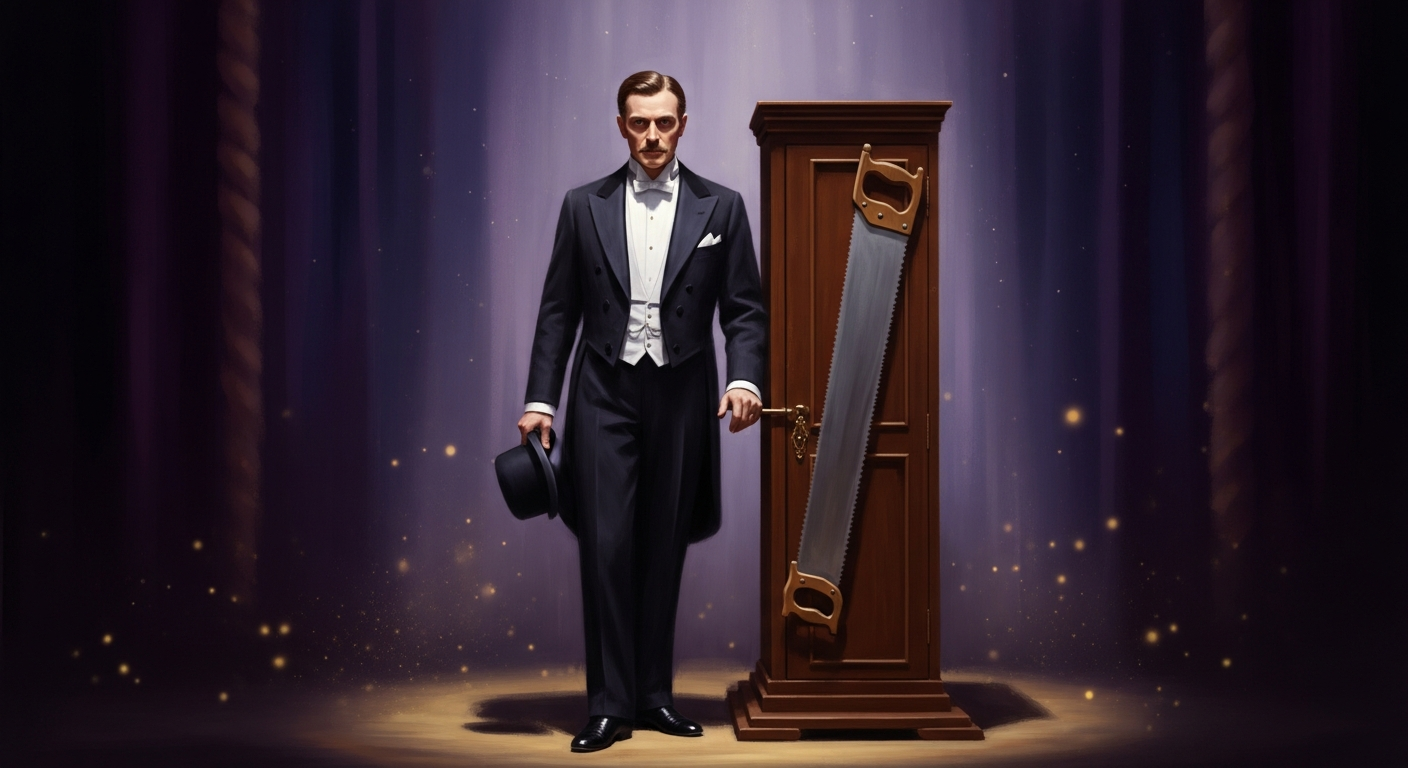
On 17 January 1921, a new illusion appeared at the Finsbury Park Empire in London: a woman was put in a wooden box and cut in half with a saw. The audience screamed. The press went wild. Within weeks it was the most discussed trick in the world — and P.T. Selbit had changed the history of magic.
From press magician to inventor
Born as Percy Thomas Tibbles in 1881 in Hampstead, he chose the anagram 'Selbit' as stage name. He was simultaneously a professional magician and editor of magic magazines — a combination that gave him insight into what the market needed.
He wasn't himself a spectacular performer. What distinguished him was his inventor's brain. He designed more than a hundred illusions in his life, of which at least thirty are still performed worldwide today.
The PR revolution
Before the premiere Selbit sent buckets of fake blood to the theatre — which got the press dying of interest. He also followed with 'Stretching a Woman' (stretching a woman to 2 metres) and 'Crushing a Woman' (crushing her under a hydraulic press). The newspaper wrote about it; ticket sales soared.
An important PR trick: he kept an ambulance ready outside the theatre, 'for emergencies'. The press took it over as if it were real. No ambulance was ever used — but the effect was perfect: people believed the trick was really dangerous.
- ✦Inventor of: Sawing a Woman in Half (1921)
- ✦Also: Stretching, Crushing, Walking Through a Brick Wall
- ✦Died in 1938, 57 years old, forgotten by the general public
The stolen legacy
Unfortunately for Selbit, he had no patent on his illusion. Within months Horace Goldin and Howard Thurston performed their own versions in America — and they became famous with it, not Selbit. Goldin was eventually generally recognised as 'the man who saws women', while Selbit fell into oblivion.
A century later, in 2021, the magic world celebrated 100 years of Sawing a Woman in Half. Finally Selbit was recognised as the original inventor. Posthumous justice for a man who never got the fame his invention deserved.
Selbit showed that the inventor of a trick and its performer can be two different heroes. His work stands in every modern theatre.