
Theo Bamberg, known worldwide by the stage name Okito, ranks among the greatest names in Dutch magic history. Born in Amsterdam on 15 July 1875 and died in Chicago on 28 June 1963, he grew from an Amsterdam boy in a Jewish family of magicians into a world-famous illusionist who performed on virtually every continent.
Visual reference
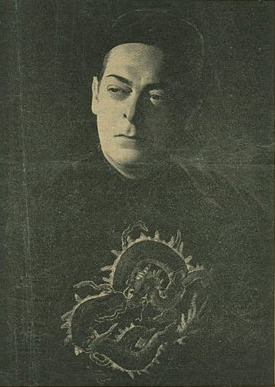
A magical dynasty of five generations
Bamberg came from a family that had passed the art of magic from father to son for five generations, beginning with Eliazer D. (Leendert) Bamberg, born around 1748. His father, David Tobias Bamberg, called himself a court mechanic and enjoyed a fine reputation at the Dutch court, bringing the family into contact with the Royal House and the Dutch elite.
Young Theo first performed at the age of eleven, alongside his father, on the occasion of Princess Wilhelmina's birthday. By seventeen he worked independently as a hand-shadow artist, presenting a show of up to two and a half hours in both the Netherlands and Belgium.
The birth of Okito
Bamberg realised early that his future reached beyond the small Netherlands. He developed a Japanese-inspired act and took the stage name Okito — an anagram of Tokio. Severe deafness, caused by a swimming accident, never hindered his performances.
In 1900 he appeared at the Théâtre des Folies Marigny in Paris with the act 'Le Japonais Mystérieux', together with a young Howard Thurston, who would later become one of America's greatest magicians. Between 1902 and 1904 Okito performed in England, culminating in a show for the Prince of Wales — the future King Edward VII — in the company of the Shah of Persia.
A world traveller with 2,000 kilos of luggage
In 1908 Bamberg left for the United States, touring the country via the Orpheum Circuit and meeting greats such as Thomas Edison and Arthur Conan Doyle. His reputation as inventor, builder, designer and painter of his own illusion apparatus was so great that his act sometimes required 2,000 kilos of luggage.
In 1909 the constant travelling wore him out and he settled on Broadway in New York with the shop Bamberg Magic & Novelty Co. When that failed, he later started a successful trade in apparatus for amateur illusionists, which lasted until 1919. That year he devised a new Chinese act with which he toured the entire world.
With that Chinese act he travelled the globe: South America, Africa, India, Egypt, China, Thailand and the Far East. After the First World War he shone at the Wintergarten and the Scala in Berlin, and later in Paris, Budapest and Vienna.
War, exile and a lasting legacy
In 1932 Bamberg returned to the Netherlands and in 1936 had the villa 'Pagode' built in Rijswijk, where he sheltered Jews who had fled Austria. When the Second World War broke out he fled on 12 May 1940 to the West Indies, forced to leave behind his attributes packed in fourteen crates; most were destroyed.
By way of Venezuela — where he joined his son David, performing as Fu Manchu — he eventually settled in Chicago. Bamberg is regarded as the first illusionist in the world able to make an object truly float; that levitation technique — with which he made a lightbulb, ball or table move through the air — forms the basis of countless later illusions, performed among others by David Copperfield and Hans Klok. In Amsterdam, the Bamberghof has commemorated this famous family of artists since 1959.
From the Dutch court to the stages of the Far East, Theo 'Okito' Bamberg carried Dutch magic to the world. It is exactly that craftsmanship and theatrical imagination that Sudesh Roman continues on stage today.